Every lifecycle model — ADDIE, SAM, LeaPS — names a sequence of activities: analyze, design, prototype, iterate. What none of them names is the thing the activities are for. The ANCHOR model is the answer, distilled from the performance-improvement tradition.
Its premise comes straight from Gilbert (2007): performance is not the behavior; it is the valuable accomplishment the behavior produces — the crop, not the plowing. A course is never the goal. A worthy accomplishment is. ANCHOR exists to keep every design decision tied to that accomplishment, and its six commitments spell its name.
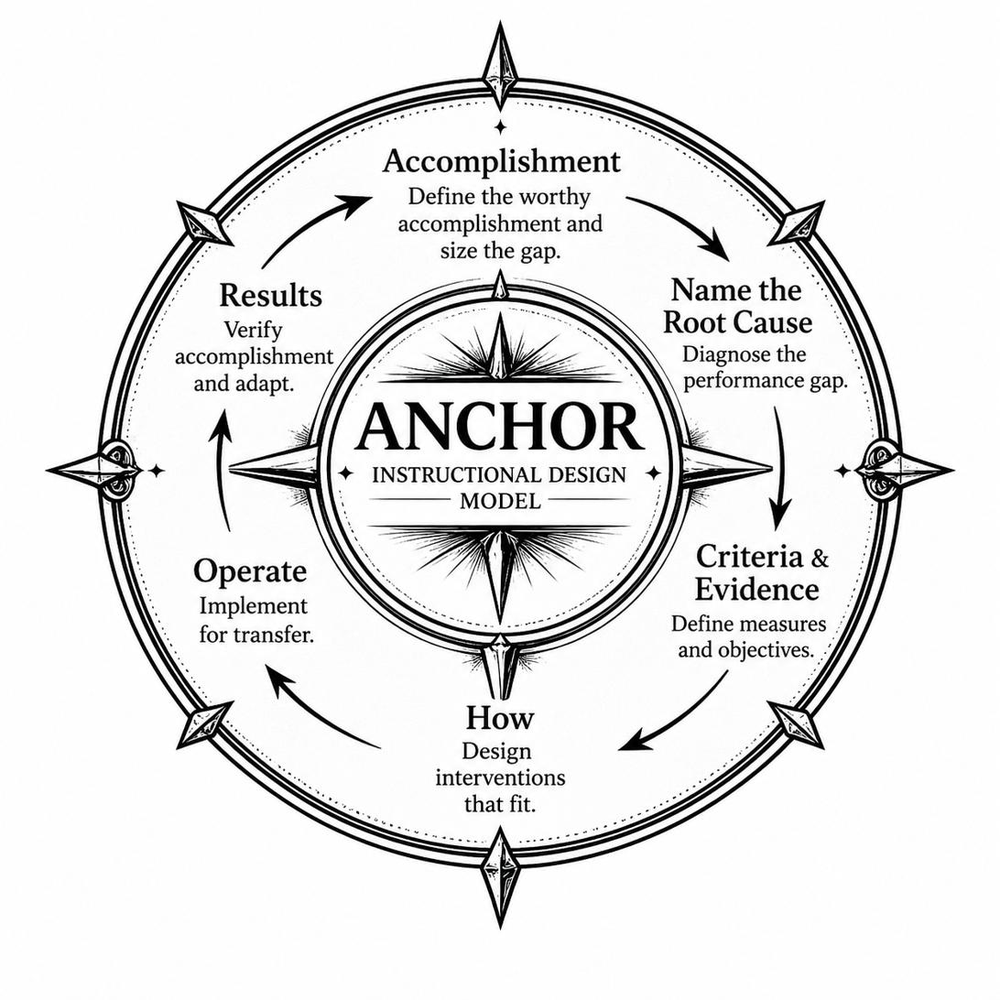
The Six Commitments
AccomplishmentDefine the worthy accomplishment and size the gap
Before anything else, pinpoint the valuable accomplishment in Gilbert’s sense and size the gap: what does exemplary performance produce, what does typical performance produce, and what is the difference worth?
Name the Root CauseDiagnose the performance gap
Run the BEM scan and the Mager screen (Mager & Pipe, 1997). Determine which of the six cells drive the gap — and whether instruction belongs in the solution at all.
Criteria & EvidenceDefine measures and objectives
Write the performance objectives — performance, conditions, criterion — and define the evaluation evidence in the same act, every objective paired with its measure and the baseline captured now (Kirkpatrick & Kirkpatrick, 2016). Evaluation is designed here, never appended later.
HowDesign interventions that fit
Orchestrate the full intervention set, not just the course: instructional elements with the modality chosen by the performance outcome, plus the environmental fixes the BEM surfaced — job aids, incentives, process changes. Prototype early; test before you scale.
OperateImplement for transfer
Implement with transfer engineered in from the start — manager reinforcement, protected practice, required drivers — because the new behavior survives or dies in the environment, not the classroom.
ResultsVerify accomplishment and adapt
Evaluate against the evidence defined at C, and judge worth the way Gilbert would: did the accomplishment rise relative to its cost? Loop back wherever the evidence says an earlier commitment missed.
Not a Rival to ADDIE
ANCHOR is not a rival to ADDIE, and that is the point. ADDIE’s phases describe what you do; ANCHOR’s commitments describe what the doing is for. The two map cleanly onto each other, so you can run ANCHOR inside ADDIE, SAM, or any lifecycle your organization prefers. The phases may iterate, compress, or overlap — but the accomplishment stays fixed beneath them.
How ANCHOR maps to ADDIE
| A · N | → Analyze — define the accomplishment and name the root cause |
| C | → Design — criteria, objectives, and the evidence to measure them |
| H | → Design / Develop — the full intervention set, prototyped and built |
| O | → Implement — rollout with transfer engineered in |
| R | → Evaluate — results judged against the accomplishment |
Learn the model in practice
A Practitioner’s Guide to Instructional Design teaches the six commitments one phase at a time, following a single real project — a customer-care coaching course — from a vague request to a finished, evaluated program.
Get the bookReferences: Gilbert, T. F. (2007). Human Competence: Engineering Worthy Performance (Tribute ed.). Mager, R. F., & Pipe, P. (1997). Analyzing Performance Problems. Kirkpatrick, J. D., & Kirkpatrick, W. K. (2016). Kirkpatrick’s Four Levels of Training Evaluation.